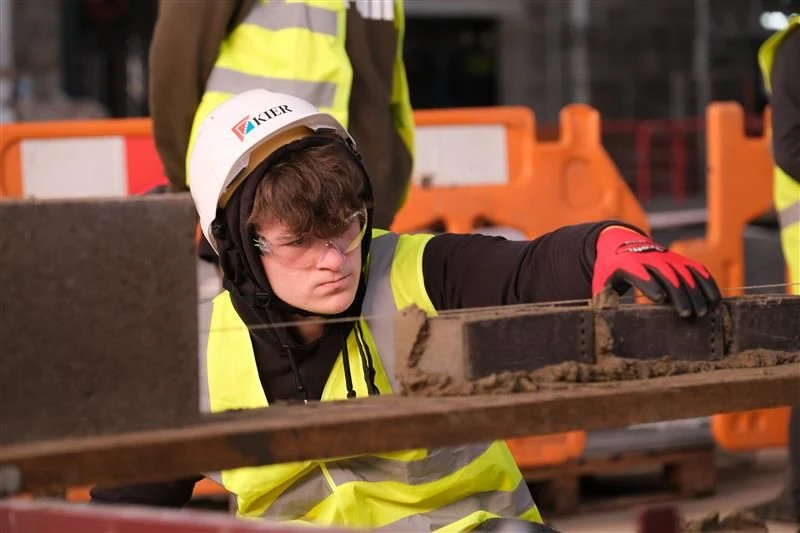

Image Source: Working Wales via LinkedIN
Senedd Home was mothballed for five long years because of a lack of support. Don’t let it happen again. This site doesn’t receive any public funding or subsidy. If you believe I’m trying something new here or like what’s being done, consider a donation. Â One-off or monthly; as little or as much as you want.
Click the links below, or full details are available here.
Youth Employment & NEETs
Is this devolved to Wales?

Devolved
The necessary powers are not reserved to the UK Parliament in Schedule 7A of the Government of Wales Act 2006.

Shared Powers
Welfare and employment law are not devolved. Education, training and career services are devolved.

Not Devolved
The powers over this are reserved to the UK Parliament in Schedule 7A of the Government of Wales Act 2006 (Specific Section/Number/Clause).
While issues such as welfare are not devolved, the Welsh Government is responsible for some aspects of employment support. The flagship scheme aimed at young people is the Young Person’s Guarantee1, which supports under-24s to find a training place, find a job or start self-employment.
Despite this, around 1-in-6 people in Wales aged 16 to 24 are not in any form of education, training or employment (called “NEETs”). This is the highest rate of the UK’s nations.
On 15th July 2026, the Senedd backed a non-binding motion calling for the Welsh Government to strengthen the Young Person’s Guarantee and set clear targets to cut the proportion of young people who are “NEETs”.
Some of the known predictors that may lead to a young person falling under the NEET category include2:
- Having a form of physical or learning disability.
- Disengaging from school before the age of 16 (i.e. truancy).
- Parents who have no qualifications or a disability.
- Being care-experienced, or having contact with social services and/or police.
- Not taking part in organised leisure activities.
Young men are more likely to become NEETs than young women.
There have also been concerns about a lack of entry-level and part-time jobs, excessive requirements for relevant experience from employers and recruitment agencies, and lack of spaces on further education courses and apprenticeships.
Some additional figures on this are available below.
Estimated 16 to 24 year olds not in education, employment or training in Wales (NEET) by economic activity and age group (custom table)
Costs & Economic Impact
Enter your description-
Cheese
-
Explanation
-
Etc
Who has raised this at the Senedd?
What are the party positions on this?
- Supports training
- Opposed
- Neutral/No Opinion
Plaid Cymru backbenchers have backed improved focus on education and vocational training places as a way to address youth unemployment.
- Supports entry-level jobs
- Opposed
- Neutral/No Opinion
Reform UK believe the hospitality and service sectors are important in providing first jobs to many young people. They have also raised the issue of graduate under-employment.
- Wants expanded support
- Opposed
- Neutral/No Opinion
Labour jointly tabled the debate on youth employment, and support expanding existing programmes like the Young Person’s Guarantee. They have added concerns about a shortage of vocational training courses at FE colleges.
- Multiple factors at play
- Opposed
- Neutral/No Opinion
The Conservatives believe that there are multiple different factors driving youth unemployment. They have also expressed concerns about a shortage of vocational course places.
- Supports green opportunities
- Opposed
- Neutral/No Opinion
The Green party believe that there will be lots of opportunities for training and apprenticeships driven by new, low-carbon industries and home retrofitting.
- Supports training
- Opposed
- Neutral/No Opinion
Jane Dodds supports an increase in the number of suitable training places, believing the Young Person’s Guarantee hasn’t lived up to its promise at the start.
What have ministers said?
What's being done about this?
The Minister has asked officials for more information on why young people are falling out of the labour market.
He has expressed support for the Young Person’s Guarantee in principle, but wants it to “grow even stronger” and will “change course where the evidence demands it”.
Both the Economy Minister and Deputy Minister for Skills have expressed a wish for more joined-up-working between employment and health support, as well as time limits on how long a young person should wait for an offer (of training or employment).
Probably not, and any laws on this are more likely to come from the UK Parliament in areas such as welfare reform and employment law.
This is an ongoing issue.
What have the Senedd's Committees said?
Nothing has been discussed yet.
Lorem ipsum dolor sit amet consectetur adipiscing elit.
Quisque faucibus ex sapien vitae pellentesque sem placerat.
In id cursus mi pretium tellus duis convallis.
Tempus leo eu aenean sed diam urna tempor.
Pulvinar vivamus fringilla lacus nec metus bibendum egestas. Iaculis massa nisl malesuada lacinia integer nunc posuere. Ut hendrerit semper vel class aptent taciti sociosqu.
Ad litora torquent per conubia nostra inceptos himenaeos.Lorem ipsum dolor sit amet consectetur adipiscing elit. Quisque faucibus ex sapien vitae pellentesque sem placerat. In id cursus mi pretium tellus duis convallis.
Relevant Votes
| Date | Motion Number | Subject | Tabled As | Binding Vote? | Votes For | Abstentions | Votes Against | Absent/No Vote | Outcome |
|---|---|---|---|---|---|---|---|---|---|
| 15/07/26 | NDM9247 | Support measures to address youth unemployment | | No | 51 | 6 | 31 | 6 | AGREED |

Further Reading
- Working Wales. “Post-16 options and support“
- UK Department of Education (May 2026). “Risk factors for becoming NEET“